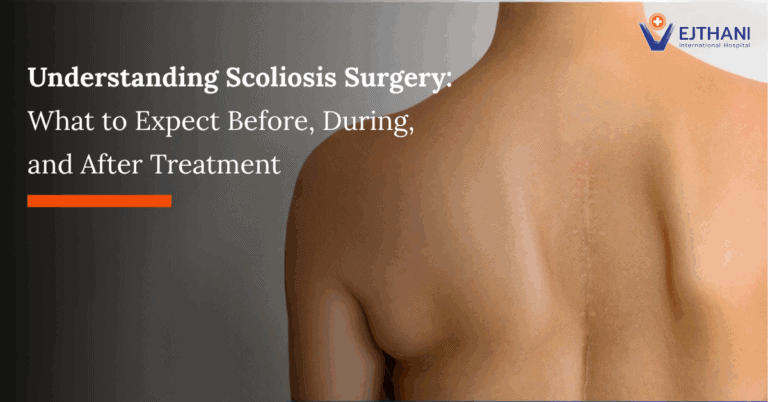
Understanding Scoliosis Surgery: What to Expect Before, During, and After Treatment
Scoliosis can be a frustrating condition that causes a great deal of pain and discomfort. Doctors work to present as many quality solutions for scoliosis
Select Topic
A bulge in the abdominal, groin, or umbilical region may be a sign of a hernia. This condition can develop at any age, in both men and women.
Based on his experience caring for patients with hernias, Dr. Thanapoom Limtrakul, a hepatobiliary surgeon specializing in robotic-assisted minimally invasive surgery at Vejthani International Hospital, has found that many patients seek medical attention only after they begin experiencing pain or notice an increase in the bulge. Many people initially assume that the lump is fatty tissue or a minor abnormality, which may prevent timely treatment and increase the chance of complications such as a strangulated hernia.
In addition, concerns about surgical scars and recovery time are often important factors for patients when considering their treatment options.
Hernia occurs when part of the intestine moves through a weakened section of the abdominal wall, creating a bulge beneath the skin.
This weakness may be present from birth or develop later in life due to prior surgery or increased intra-abdominal pressure. Common causes of increased abdominal pressure include straining due to constipation, chronic coughing or sneezing, and heavy lifting.
The types of hernias are determined by their location within the abdominal wall.
This is the most common type, particularly among men. It develops in the groin area due to weakness in the surrounding abdominal muscles.
This type occurs around the navel and can affect both children and adults, especially individuals who are overweight and pregnant women.
This condition develops in an area where surgery was previously performed because the abdominal wall there has not fully recovered.
This type is less common and is more frequently seen in women. It occurs in the upper thigh region.
Symptoms may vary from person to person. Common signs and symptoms include:
If the bulge cannot be pushed back into the abdomen or is accompanied by severe pain, immediate medical attention is recommended, as this may indicate an incarcerated or strangulated bowel.
A hernia develops when weakness of the abdominal wall is combined with increased pressure within the abdominal cavity.
Factors that may increase the risk include:
Surgical repair is the standard treatment because a hernia does not heal on its own. Several surgical approaches are currently available.
Laparoscopic surgery is a minimally invasive surgical technique. The surgeon inserts a laparoscope and surgical instruments through approximately three to four small incisions in the abdomen. The camera provides a clear view of the abdominal cavity on a monitor, allowing the surgeon to return the protruding tissue to its original position. However, conventional laparoscopic instruments have limited mobility, making suturing in deep areas more challenging. As a result, surgical tacks may be required to secure the mesh to the abdominal wall.
Some patients may experience a sensation of tightness after surgery due to the use of these fixation devices.
The Da Vinci Surgical System is an advanced robotic-assisted technology used in minimally invasive surgery. During the procedure, the surgeon controls robotic instruments through a computerized system while operating through small incisions. The system provides high-definition three-dimensional visualization, allowing surgeons to view internal anatomical structures in greater detail and perform delicate surgical maneuvers with enhanced precision.
Following surgery, patients should take appropriate measures to support healing and recovery, including:
If you experience a bulge in the abdomen or groin, particularly one that grows or becomes painful, seek prompt medical evaluation. Early diagnosis and appropriate treatment can help prevent complications and improve outcomes.
No. Hernias do not resolve on their own. Surgical repair is the only definitive treatment and is recommended to prevent progression and reduce the risk of future complications.
Traditional open surgery requires a larger incision and generally involves a longer recovery period. Both laparoscopic and robotic-assisted techniques use smaller incisions and are designed to minimize tissue disruption. Robotic-assisted surgery offers enhanced precision, greater instrument flexibility, and may help reduce postoperative discomfort in selected patients. The most appropriate approach depends on each patient’s condition and the surgeon’s evaluation.
You should consult a doctor if you notice a lump or bulge in the abdomen, groin, or navel, particularly if it increases in size or causes discomfort. Immediate medical attention is necessary if the bulge becomes painful, cannot be pushed back in, or is accompanied by nausea, vomiting, or severe abdominal pain, as these symptoms may indicate a surgical emergency.
For more information, please contact
Surgery Center, Vejthani International Hospital
Call: (+66)2-734-0000 Ext. 4500, 4501
English Hotline: (+66)85-223-8888