Make an Appointment
 Talk to Doctor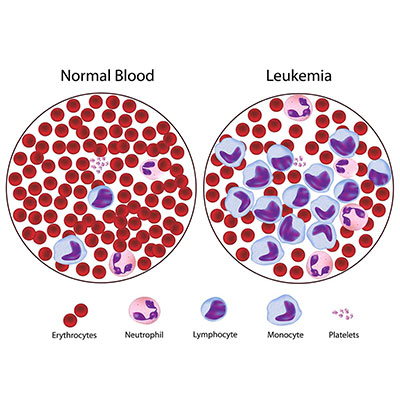
Overview
Leukemia is the cancer of the blood-forming tissues, it generally affects the white blood cells. The white blood cells are a part of the blood component of the body that are infection-fighting cells that normally grow and multiply as needed by the body. However, for people with leukemia, their bone marrow produces an excessive number of abnormal and poorly functioning white blood cells.
Leukemia does not generally form into a tumor or a mass unlike other cancer and will not be seen on imaging test such as CT-scan or X-ray. Some types of leukemia are more common among children. Most cases of other types of leukemia are in adults.
Classification of Leukemia
Classification by how fast the disease progresses:
- Acute leukemia: The abnormal cells are blasts (immature cells) which multiply quickly. The disease requires immediate treatment because the disease could quickly worsen. It is commonly found in children.
- Chronic leukemia: The disease comes in different types, some cause the production of either too few or too many cells. More advanced blood cells are involved in chronic leukemia. These blood cells can continue to operate normally despite their slower rate of reproduction or accumulation. Certain types of chronic leukemia don’t show any symptoms, and may be undetected or undiagnosed for a period of time. This type commonly found in adults.
Classification by type of white blood cell affected:
- Lymphocytic leukemia – the type of leukemia that affects the lymphoid cells (lymphocytes), that forms into lymphoid or lymphatic tissue.
- Myelogenous leukemia – the type of leukemia that affects the myeloid cells, increasing the red blood cells, white blood cells and platelet-producing cells.
Major types of Leukemia
- Acute lymphocytic leukemia (ALL) – the most common type of leukemia in young children, however it could also affect adults.
- Acute myelogenous leukemia (AML) – the most common type of acute leukemia in adults, however it could also affect children.
- Chronic lymphocytic leukemia (CLL) – the most common type of chronic leukemia in adults (common to people 65 years old and above).
- Chronic myelogenous leukemia (CML) – the type of leukemia of older adults however it affects all adults of any age. Symptoms may not appear for years in person with CML.
Symptoms
The symptoms depend on the type of leukemia, as follows:
- Fatigue or body malaise
- Fever
- Night sweats
- Frequent infections
- Unexplained weight loss
- Swollen lymph nodes, enlargement of liver or spleen
- Bleeding, or unexplained bruising
- Excessive sweating, especially at night
- Bone or joint pain
If you notice any signs and symptoms please make an appointment with your doctor.
Causes
The causes of leukemia have not been discovered. Blood cells’ DNA undergoes mutations as a result of some error. The abnormal cells multiply out of control as a result of cell mutation. These abnormal blood cells may destroy healthy blood cells in the bone marrow, reducing the quantity of healthy platelets, red blood cells, and white blood cells.
Risk factors
Factors that may increase leukemia risk include:
- Hereditary – there is a higher risk to develop leukemia if member of the family is diagnosed with the disease.
- History of cancer treatment – the person who undergone chemotherapy and radiation therapy for other cancers has an increased risk of developing leukemia.
- Smoking – first-hand smoking or second-hand smoking have increased risk to develop acute myelogenous leukemia. (1.0)
- Genetic disorder– the abnormalities could increase the risk to develop leukemia. Genetic disorder such as Down Syndrome and others.
- Chemical exposure – chemicals such as benzene and formaldehyde are known to cause cancer.
Diagnosis
Blood test results could help the physician identify if the patient has an acute or chronic leukemia. Other tests such as the following are needed for proper diagnosis.
- Physical exam – to look for signs of leukemia, such as pale skin, skin bruising, swelling of the lymph nodes, and enlargement of the liver and spleen.
- Blood tests – abnormal blood results of red blood cells, white blood cells, or platelets could suggest leukemia. However, not all types of leukemia cause abnormal cells circulate in the blood, some are found in the bone marrow.
- Bone marrow biopsy (bone marrow aspiration) – a long, thin needle is inserted into the bone marrow (commonly at the hip bone) to aspirate fluid during the procedure, then the sample is sent to laboratory for pathology testing to determine the percentage of abnormal cells and diagnose leukemia.
Treatment
The type, location and stage of cancer are some of the factors which can affect how to choose the treatment and would be discussed with the specialist.
- Chemotherapy: most common therapy for leukemia, it uses drugs to kill cancer cell.
- Radiation therapy: uses high-energy beams to kill or stop the growth of cancer cells. The treatment may be used prior to bone marrow transplant. During the therapy radiation may be directed to one area or over your whole body.
- Targeted therapy: is designed to focus on blocking certain abnormalities that present in the cancer cells. This process could help prevent cancer cells from multiplying or kill the cancer cells.
- Bone marrow transplant (stem cell transplant): this procedure helps to reconstitute the healthy stem cells. It substitutes abnormal bone marrow with stem cells that does not contain leukemia and recreates healthy bone marrow. Before a bone marrow transplant, very high doses of chemotherapy or radiation therapy is administered to kill the bone marrow that produces leukemia cells. Then, stem cells from a compatible donor will be infused.
- Immunotherapy: is the use of drug to help the immune system fight against cancer. As cancer cells create proteins, it makes it difficult for immune system to attack cancer cells. As a result, cells in the immune system cannot recognize that cancer cells are harmful. Immunotherapy becomes effective by interfering that natural process.