Make an Appointment
 Talk to Doctor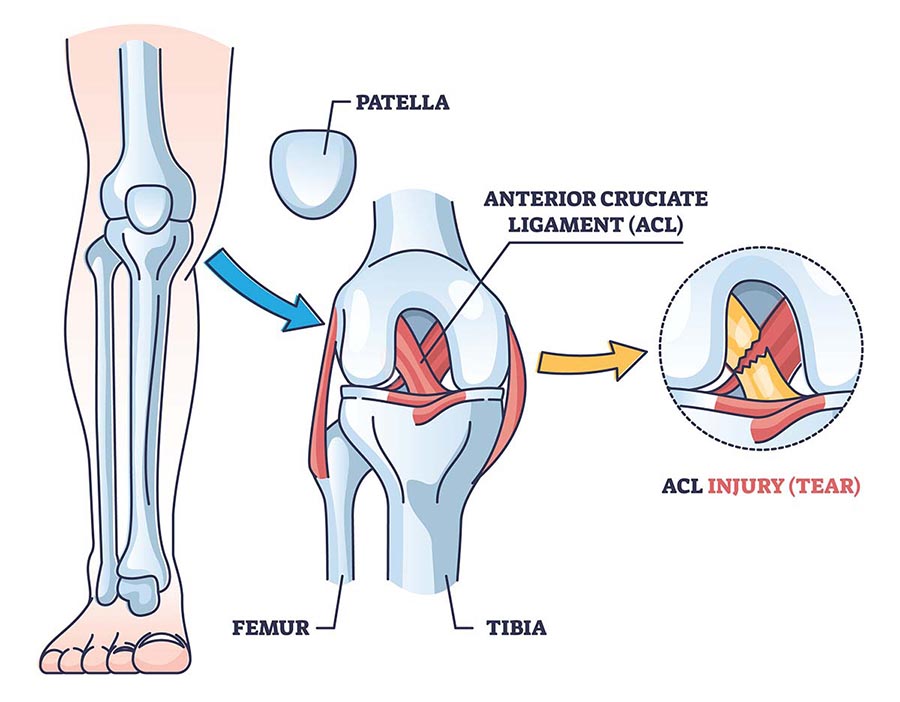
Overview
The Anterior Cruciate Ligament (ACL) is a powerful connective tissue of the thigh bone and shinbone which stabilizes the knee. When this ligament is torn or sprained during sports activities (most common cause) which involves excessive utilization of the knee, ACL Injury occurs.
Signs & Symptoms
The following are the signs and symptoms of an ACL injury:
- Loud popping sound or sensation
- Immediate Swelling
- Feeling unstable or inability to bear weight on the knee
- Intense pain
- Loss of knee motion
- Unable to pursue activities
If you feel any of these signs and symptoms when you had a knee injury, see a doctor immediately.
Causes
Non-contact injuries often cause ACL to tear while engaging in sports or fitness activities which impacts the knee such as:
- Sudden switch of direction, rotating the knee
- Unstable landing from jumping
- Abruptly stops while running
- Strong impact of the knees with another person, such as during a football tackle
ACL injury is either incomplete or complete, although it can still be unimpaired from a minor injury even if it is being stretched.
Risk factors
The following are at risk of developing an ACL Injury:
- Athletes and those who engage in sports or fitness activities that impacts the knees
- Gender women has more risk due to physical structure or condition, hormonal changes and muscular power.
- Lack of conditioning
- Faulty movement during activities involving the knees
- Unstable or damaged sports equipment
- Unfit footwear or gear
- Using artificial grass on the ground during sports
Diagnosis
The doctor usually checks for swelling or tenderness of the knee, and moves your knee at certain directions to check for your knee’s entire function and range of motion. On the other hand, your doctor may order the following test to confirm the injury:
- X-ray. Checks for any broken bones
- Magnetic Resonance Imaging (MRI). Shows images of both hard and soft tissues, as well as the cartilage using radio waves and a powerful magnetic field. MRI shows how broad is the ACLinjury and other indications of injury to other tissues in the knee.
- Ultrasound. Views ligament, tendon and muscle injury using sound waves.
Treatment
A home remedy known as R.I.C.E is used to decrease swelling and pain from damaged knee.
- Rest. Promotes healing and prevents knee from weight-bearing activities.
- Ice. Apply ice for 20 minutes every 2 hours while awake.
- Compression. Compress your knee by wrapping it in an elastic bandage.
- Elevation. Elevate your knee on a pillow while lying down.
Rehabilitation
You will be instructed by a physical therapist with exercises that you can do with or without supervision to decrease swelling and pain, restore knee movement, and gain muscle strength. This usually resolves ACL injury if done properly. Braces can also be used for a more stable knee movement, together with crutches for a while in order to protect your knee from weight-bearing activities. Physical therapy is usually provided along with medical treatment.
Surgery
Surgery is recommended in situations such as if you are an athlete and still wants to continue playing your sport, if the damage is in more than one ligament or cartilage, and your knee problem hinders you from activities of daily living.
ACL reconstruction is recommended for an ACL injury. It gets rid of the injured ligament and replaces it with a part of the tendon (from your other knee or a cadaver’s knee) called grafting. The tendon is used because it has the same function as the ligament connecting the muscle to the bone.
You will be able to carry on with your physical therapy after a successful ACL reconstruction surgery to be able to regain your muscle strength and stability. Also, do not forget to take the prescribed medication by the doctor.
Athletes may return to play their sports safely as early as one year or more. Make sure that you have had ample physical therapy guided by your doctor and physical therapist to guarantee that you regain your best range of motion, strength and stability when you return to your game.
If you follow the doctor’s recommendation and comply with your physical therapy, you will be able to regain the normal life you used to live.