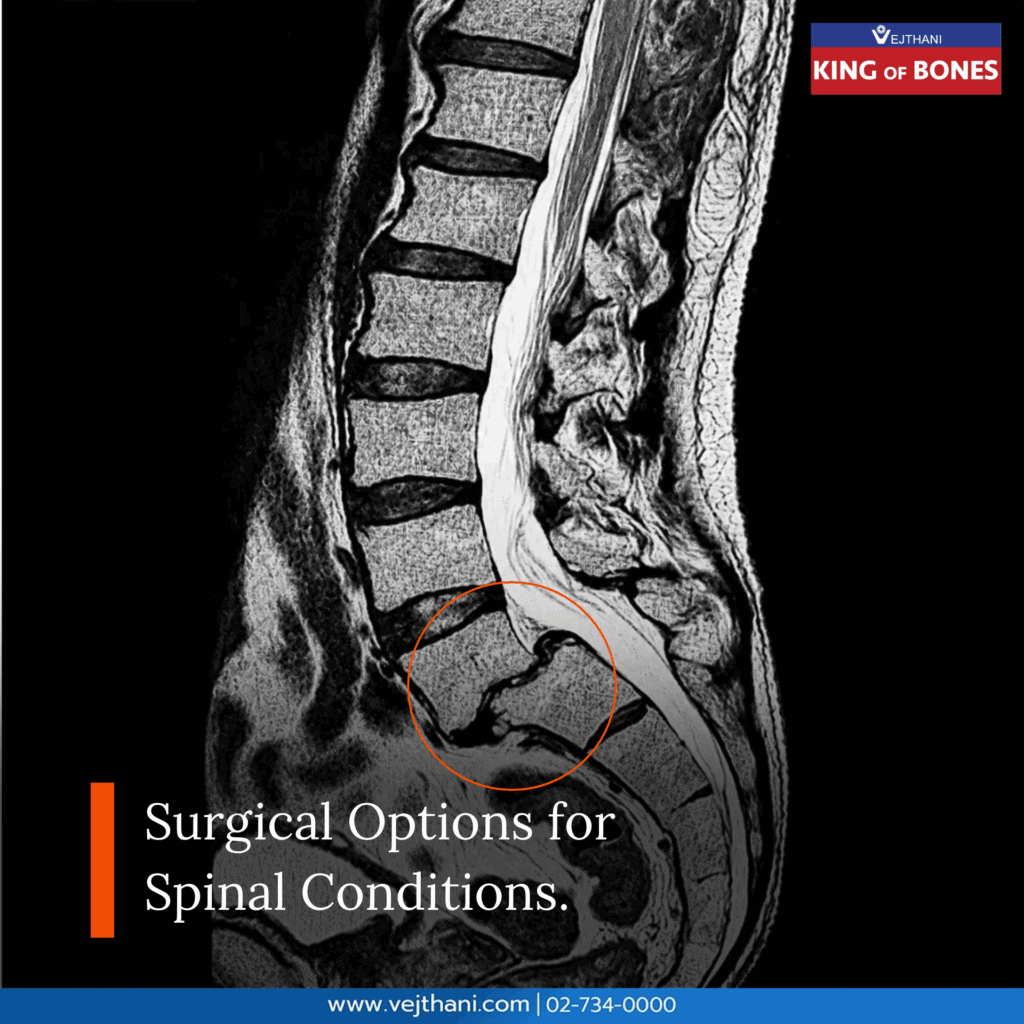
Spine surgery may be considered when persistent pain, nerve compression, or spinal instability affects daily activities and does not improve with non-surgical treatment. In some cases, if nerve symptoms continue to worsen, surgeons may consider surgery early to reduce the risk of long-term problems.
The goal of spine surgery depends on the problem being treated. Some procedures relieve pressure on compressed nerves, while others stabilize the spine or help preserve movement. Surgeons may use endoscopic, microscopic, or minimally invasive techniques for certain procedures to limit damage to surrounding muscles and tissues.
Not every spinal condition requires surgery. Doctors consider the patient’s symptoms, examination findings, imaging results, and overall health before recommending the most appropriate treatment.
When Is Spine Surgery Necessary?
Doctors may recommend spine surgery when persistent symptoms continue despite non-surgical treatments, such as medication, physical therapy, or injections. In some cases, nerve compression or spinal instability may require surgery sooner, particularly when symptoms begin to affect movement or nerve function.
Several factors may lead doctors to consider surgery:
Persistent pain: Back, neck, arm, or leg pain that continues despite appropriate treatment and significantly interferes with daily activities.
Nerve compression: Pressure on spinal nerves that causes ongoing pain, numbness, tingling, or muscle weakness.
Spinal instability: Excessive movement between vertebrae that affects spinal stability and may require surgical treatment.
Worsening neurological symptoms: Increasing muscle weakness, difficulty walking, or loss of hand coordination due to pressure on the spinal cord or nerves.
Seek emergency care for sudden bladder or bowel control problems, numbness around the groin or inner thighs, or muscle weakness that worsens rapidly.
Not everyone with a spinal condition needs surgery. Doctors assess symptoms, physical exam findings, imaging results, and responses to previous treatments before recommending an appropriate approach.
Diagnosis Before Spine Surgery
Depending on the spinal condition, doctors may recommend the following tests for diagnosis:
X-rays: Show spinal alignment, bone changes, and signs of instability.
Magnetic Resonance Imaging (MRI): Provides detailed images of spinal discs, nerves, and surrounding soft tissues. It helps doctors identify conditions such as herniated discs or spinal stenosis.
Computed Tomography (CT): Shows the spinal bones in detail and can reveal fractures or shape changes.
Not every patient needs all these tests at once. Doctors recommend each diagnostic test based on symptoms and physical exam findings.
Imaging results alone do not determine whether the patient needs surgery. Doctors also consider how closely the findings match the patient’s symptoms, the severity of nerve involvement, and the response to previous treatments. H2: Types and Techniques of Spine Surgery
Spine surgery includes several procedures that address different spinal problems. Some relieve pressure on nerves, while others stabilize the spine or treat damaged structures. Doctors choose a procedure based on the underlying condition, the problem’s location, and the patient’s symptoms.
H3: Spinal Decompression and Discectomy
Spinal decompression and discectomy help relieve pressure on spinal nerves, but they address different causes of nerve compression.
Spinal Decompression: Creates more space around compressed nerves by removing bone or tissue that narrows the spinal canal or the openings where nerves exit the spine. Common procedures include laminectomy and foraminotomy.
Discectomy: Removes the portion of a herniated disc that presses on a spinal nerve.
Doctors may recommend these procedures when nerve compression causes persistent pain, numbness, or weakness, particularly when non-surgical treatments have not provided sufficient relief. The choice of procedure depends on the source of nerve compression and the extent of the spinal changes.
Spinal Fusion Surgery
Spinal fusion connects two or more vertebrae to stabilize that part of the spine and limit painful movement. Doctors may recommend this procedure for certain conditions, such as spinal instability, spondylolisthesis, or spinal deformities. Some patients may also need spinal fusion alongside decompression surgery.
During the procedure, surgeons use bone graft material to help the vertebrae grow together. Sometimes screws, rods, or other implants are used to support the spine while the bones heal.
Several surgical approaches allow surgeons to reach different areas of the spine:
TLIF (Transforaminal Lumbar Interbody Fusion): Accesses the lumbar spine from the back and slightly to one side.
PLIF (Posterior Lumbar Interbody Fusion): Approaches the lumbar spine directly from the back.
ALIF (Anterior Lumbar Interbody Fusion): Reaches the lumbar spine through the abdomen.
OLIF (Oblique Lumbar Interbody Fusion): Uses an angled approach from the side of the abdomen.
XLIF (Extreme Lateral Interbody Fusion): Accesses the lumbar spine from the side of the body.
Each approach has different advantages and limitations. Doctors consider the location of the spinal problem, the patient’s anatomy, and the need for nerve decompression before selecting a surgical technique.
Non-fusion surgery: Microscopic, Endoscopic Spine Surgery
Minimally invasive spine surgery uses smaller incisions and specialized instruments to treat certain spinal conditions while reducing disruption to surrounding muscles and tissues. Surgeons may use different techniques depending on the procedure and the spine area requiring treatment.
Endoscopic Spine Surgery: Through a small incision, the surgeon uses a tiny camera and instruments to remove disc material or relieve nerve pressure.
Microscopic Spine Surgery: Surgeons use an operating microscope to magnify spinal structures and improve visibility during procedures such as discectomy or decompression.
These techniques can help surgeons access and treat spinal problems with greater visibility and less disruption to surrounding tissues in selected cases. However, not every spinal condition suits a minimally invasive approach. Doctors choose the surgical method based on the patient’s diagnosis, spinal anatomy, and treatment needs.
Other Spine Surgeries
Some spinal conditions require different surgical approaches depending on the patient’s diagnosis, symptoms, and treatment needs.
Procedure
What It Involves
When Doctors May Consider It
Artificial Disc Replacement
Replaces a damaged spinal disc with an artificial implant to help preserve movement.
Selected patients with cervical disc problems that cause nerve or spinal cord compression.
Vertebroplasty
Uses medical bone cement to strengthen a fractured vertebra.
Certain painful spinal compression fractures, particularly those related to osteoporosis.
Kyphoplasty
Uses a balloon to create space inside a fractured vertebra before injecting bone cement.
Selected spinal compression fractures, sometimes with the aim of restoring some vertebral height.
Revision Spine Surgery
Involves another operation to address problems following previous spine surgery.
Persistent or recurring nerve compression, spinal instability, or complications involving surgical implants.
Technology Used During Spine Surgery
Specialized technologies are used for optimal safety during spine surgeries. , These technologies also provide additional information during surgery and help surgeons make precise decisions.
O-arm 3D Imaging: Captures detailed three-dimensional images of the spine during surgery. Surgeons use these images to examine bone structures and the position of surgical implants.
3D Surgical Navigation: Uses imaging data to help surgeons identify spinal structures and guide instruments during surgery. When combined with O-arm imaging, the system provides real-time guidance based on the patient’s anatomy.
Intraoperative Neuromonitoring (IOM): Provides real-time visualization that enables surgeons to monitor the placement of medical equipment even at a millimeter, eliminating the need for large incisions. It also reduces the risk of nerve damage during implant insertion, which is crucial in complex spinal surgeries where spinal realignment is essential. It monitors spinal cord function in real time to prevent nerve injuries during the surgery.
Goals of Spine Surgery
Spine surgery focuses on treating the underlying cause of symptoms, particularly when nerve compression or spinal instability affects daily activities. The benefits depend on the spinal condition, the specific operation, and the patient’s general health
Depending on the procedure, surgery may help:
Reduce pain in the arms or legs: When a compressed nerve causes pain to spread from the neck or lower back, surgery may help relieve it.
Improve nerve function: Help patients regain strength or reduce symptoms such as numbness and tingling when nerve compression causes them.
Improve spinal stability: Reduce abnormal movement between vertebrae in patients who require spinal fusion.
Support movement and daily activities: Make walking, standing, and other everyday activities more comfortable as symptoms improve.
Improvement varies from person to person. Some patients experience substantial symptom relief, while others may continue to have pain, numbness, or weakness after surgery. Patients with long-standing nerve compression may also experience a slower or less complete recovery of nerve function.
Post Spine Surgery: Recovery and Rehabilitation
Recovery after spine surgery varies by procedure, area treated, and the patient’s overall health. Short, regular walks can help with t recovery, while prolonged bed rest is generally discouraged. Instructions on wound care, pain relief, driving, and activities such as bending, lifting, or twisting depend on the procedure and should be followed as per doctor’s recommendation. .
Rehabilitation is required to regain strength and return to everyday activities. After spinal fusion, discomfort may improve before the bones have fully joined; bone healing can take several months. Follow-up visits help your doctor to assess recovery and adjust activity guidance as needed.
Spine Surgery in Thailand
Choosing where to have spine surgery starts with understanding the cause of symptoms and the available treatment options. Surgery may not be needed in every case, so the first step is a careful assessment of the spine and overall health.
At Vejthani International Hospital, the Spine Center treats spinal stenosis, herniated discs, scoliosis, and spinal injuries. Depending on the diagnosis, treatment may involve physical therapy, image-guided injections, or minimally invasive surgery. With the use of O-arm 3D imaging and navigation to enhance safety, while intraoperative neuromonitoring tracks nerve function during the surgery.
Frequently Asked Questions (FAQ)
When should spine surgery be considered instead of non-surgical treatments?
Surgery may be considered when diagnostic tests rule out a specific spinal problem and symptoms continue to limit daily activities despite appropriate non-surgical treatment. Consider surgery sooner if nerve function is worsening.
What diagnostic tests may be needed before spine surgery?
No single diagnostic approach fits everyone. Assessment usually includes a review of symptoms and medical history, a physical examination, and imaging chosen for the condition. X-rays show bones and alignment; MRI can show discs and nerves; CT provides detailed bone images. Nerve tests or other studies may be added when needed.
What is the difference between spinal decompression and spinal fusion surgery?
Decompression removes or reduces tissue that is pressing on nerves or the spinal cord. Fusion joins two or more vertebrae to limit movement and stabilize that part of the spine. The procedures address different problems, though a surgeon may recommend them together when both nerve pressure and instability need treatment.
What technologies are used during spine surgery to improve precision and safety?
Depending on the procedure, surgeons may use O-arm 3D imaging to view spinal structures, navigation to guide instruments, and intraoperative neuromonitoring to track nerve signals during surgery. These tools support the surgical team but are not needed for every procedure.
We use cookies to manage your personal information in order to provide you with the best personalized user experience on our website. If you continue using the website, we assume that you accept all cookies on the website. Find out more.