Endovascular Surgery is Less Invasive Approach to Vascular Diseases
Health Articles
Select Topic
Endovascular surgery gives doctors a way to treat vascular disease without making a large incision. Doctors use this approach for narrowed arteries, blood clots, aortic aneurysms, and other problems that affect blood flow. A smaller access point often means less disruption to the surrounding tissue, but it does not make the treatment suitable for everyone. Disease location, blood vessel structure, and expected long-term outcomes all influence the decision.
What Is Endovascular Surgery?
This minimally invasive approach treats problems in the arteries and veins from inside the blood vessel. The procedure starts with a small puncture, usually in the groin or wrist. The doctor then guides a thin catheter toward the affected area while following its position on real-time X-ray images. The doctor passes instruments through the catheter to open a narrowed artery, remove a blood clot, or support a weakened vessel.
Endovascular Surgery Treats More Than Blocked Arteries
Blocked arteries are only one reason doctors use endovascular procedures. Doctors also use them for weakened or torn blood vessels, blood clots, and internal bleeding.
Atherosclerosis and narrowed arteries: Plaque buildup narrows the arteries, reducing blood flow. Depending on its location, atherosclerosis can lead to peripheral artery disease in the legs or carotid artery disease in the neck. Doctors choose angioplasty, stent placement, or atherectomy to restore blood flow in selected cases.
Aortic aneurysm: A stent graft creates a new path for blood inside the aorta, reducing pressure on the weakened and enlarged section.
Blood clots: A small device removes the clot, or a catheter delivers clot-dissolving medicine directly to it.
Blood vessel injury or internal bleeding: A stent graft covers the damaged area, while embolization blocks the specific vessel causing the bleeding.
The choice depends on the affected vessel, disease severity, and the risks of both endovascular therapy and open surgery.
Types of Endovascular Procedures
All endovascular procedures begin with a small access point. What happens next depends on the problem. A narrowed artery needs more space; a weakened vessel wall needs support; a clot or bleeding vessel requires a different solution.
Angioplasty
Angioplasty uses a tiny balloon at the tip of a catheter to widen a narrowed artery. Once the balloon reaches the narrowed section, it expands, pressing the buildup against the artery wall and making more room for blood to flow. The doctor then deflates the balloon and withdraws it.
Stent Placement
Angioplasty opens the artery, but the treated area sometimes needs extra support to stay open. In this case, the doctor places a small mesh tube called a stent inside the artery. The stent stays in place and lets blood flow through its center.
Atherectomy
Hard or heavily calcified plaque does not always respond well to balloon treatment. The doctor advances a small device through the catheter to remove part of the buildup. Angioplasty or stent placement often follows to widen and support the treated area.
Stent Grafting
During stent grafting, the doctor places a fabric-covered metal tube inside the weakened section of the aorta. Blood flows through the graft instead of pressing directly against the aneurysm wall, reducing the risk of further expansion or rupture. Endovascular aneurysm repair (EVAR) treats abdominal aortic aneurysms, while thoracic endovascular aortic repair (TEVAR) treats aneurysms in the chest.
Thrombectomy and Thrombolysis
Doctors treat a blood clot either by removing it or dissolving it. Thrombectomy pulls the clot out with a small device or suction. Thrombolysis delivers clot-dissolving medicine directly through a catheter. The doctor chooses between them based on the clot and the patient’s bleeding risk.
Embolization
To control internal bleeding, the doctor guides a catheter to its source and releases tiny coils, particles, or a liquid agent into the vessel. The material blocks blood flow at that point. Doctors also use embolization to close abnormal vessels.
Doctors also use catheter-based techniques to treat certain heart valve conditions. TAVR, also called TAVI, involves passing a replacement valve through an artery and placing it inside the narrowed aortic valve without opening the chest. Although the procedure follows a similar route through the blood vessels, it belongs to structural heart treatment rather than vascular surgery.
The Steps of an Endovascular Procedure
The details vary with each condition, but the procedure generally follows these steps:
Before treatment, the medical team uses ultrasound, CT, MRI, or angiography to locate the affected vessel and plan the route. They also review kidney function, medications, and any history of contrast allergy.
In the procedure room, the patient receives local anesthesia with sedation or general anesthesia, depending on the procedure. The doctor then makes a small puncture, usually in the groin or wrist.
Through this access point, the doctor guides a catheter toward the affected vessel under real-time X-ray imaging. Contrast dye helps reveal the route and treatment area.
After treatment, the doctor removes the catheter and closes the puncture site. The care team checks circulation, watches for bleeding, and monitors the patient during the first hours of recovery.
What Is the Difference Between Endovascular and Open Vascular Surgery?
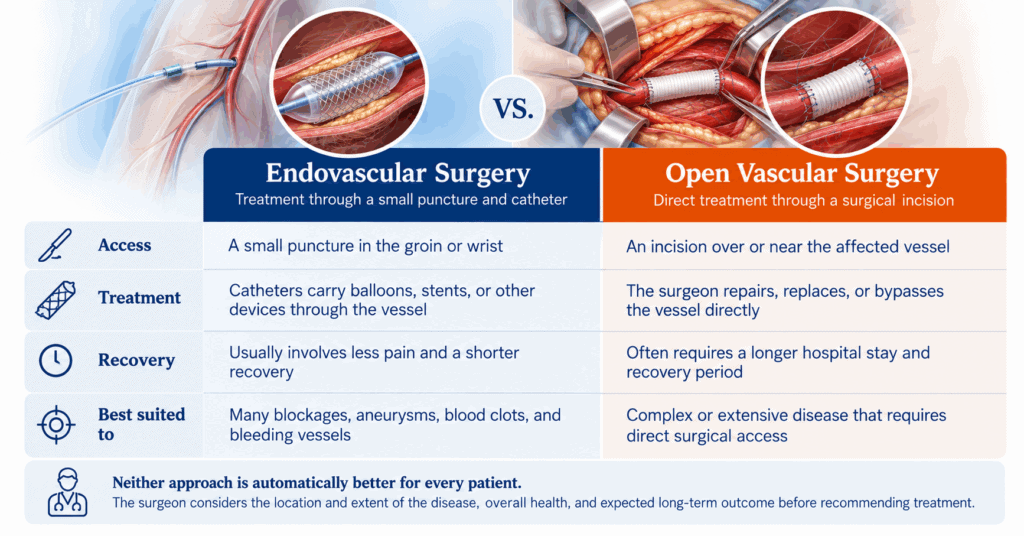
The clearest difference is how the surgeon reaches the affected blood vessel. In endovascular surgery, the surgeon guides a catheter through a small puncture. Open vascular surgery uses an incision that gives the surgeon direct access to the vessel.
A smaller incision does not always make endovascular treatment the better option. The surgeon looks at the location and extent of the disease, the patient’s overall health, and how well each approach is likely to hold up over time. Complex cases sometimes require a combination of both techniques.
What Doctors Consider Before Recommending Endovascular Surgery
Doctors use imaging scans to determine whether the affected vessel is suitable for endovascular therapy and whether a stent or stent graft will fit securely. The vessel’s size, shape, and location affect what the doctor can do. The assessment also covers the patient’s overall health, kidney function, bleeding risk, and previous operations. Endovascular surgery often offers an alternative for patients who face greater risks from open surgery. If the vessel structure makes catheter treatment difficult or the repair is unlikely to last, open surgery may provide a better option.
Benefits and Risks of Endovascular Surgery
A smaller access point often shortens recovery time compared with open surgery, but it does not eliminate all risks. The type of vascular disease, the procedure, and the patient’s overall health also affect the outcome.
Benefits
The small puncture disturbs less muscle and surrounding tissue.
Patients often experience less pain and blood loss after treatment.
Many leave the hospital sooner and return to daily activities earlier.
The smaller wound usually leaves less visible scarring.
Risks
Problems where the catheter enters: Bleeding or bruising sometimes appears around the puncture in the groin or wrist. The area can also become infected.
Damage inside the vessel: Moving a catheter or device through the vessel can injure the vessel wall or trigger a new blood clot.
Reaction to contrast dye: Contrast dye may cause an allergic reaction or affect kidney function, especially in patients with preexisting kidney disease.
Problems related to a specific procedure: After EVAR, blood sometimes continues to enter the area around the stent graft. Doctors call this an endoleak. After angioplasty, the treated artery may gradually narrow again.
Recovery After Endovascular Surgery
During the first few hours, the doctor checks the puncture site and blood flow in the treated area. Once the patient feels stable, they can usually begin walking. A straightforward procedure may allow the patient to return home on the same day or the following day. At the same time, aneurysm repair and other complex endovascular treatments require more time in the hospital.
A small bruise or mild tenderness around the groin or wrist often remains for a few days. Daily activities can resume gradually, although heavy lifting needs to wait until the doctor gives clearance. Patients with a stent or stent graft also return for follow-up imaging so the doctor can check its position and blood flow through the vessel.
Vascular Care at Vejthani International Hospital
Endovascular surgery offers a less invasive treatment option, but the smallest incision does not always lead to the best long-term results. The right approach depends on the affected vessel, the extent of the disease, and the patient’s overall health. A detailed assessment helps determine whether endovascular treatment, open surgery, or a combination of both is most suitable.
At Vejthani International Hospital, vascular surgeons review imaging results and assess each patient before planning treatment. The team provides both vascular surgery and catheter-based procedures for conditions involving narrowed, blocked, weakened, or damaged blood vessels. Patients also receive follow-up care based on the procedure and their individual risks.
FAQ
Can Endovascular Surgery Treat Blood Vessels in the Brain?
The doctor uses neuroendovascular procedures to treat certain brain aneurysms and blood clots that cause stroke. These procedures require assessment by a specialist in the brain’s blood vessels. Read more about brain aneurysm treatment.
Is Endovascular Surgery Safer Than Open Surgery?
The smaller access point generally causes less tissue damage, bleeding, and pain than a large incision. It does not make endovascular surgery safer in every case. Extensive disease or a vessel that is difficult to reach with a catheter sometimes makes open surgery the safer or more durable option.
How Long Is the Recovery Time After Endovascular Surgery?
Recovery time after endovascular surgery varies by procedure and the patient’s condition. After a straightforward catheter procedure, patients often return home on the same day or the following day. Aneurysm repair and other complex procedures usually require closer monitoring and a longer hospital stay.
FAQ
Can Endovascular Surgery Treat Blood Vessels in the Brain?
The doctor uses neuroendovascular procedures to treat certain brain aneurysms and blood clots that cause stroke. These procedures require assessment by a specialist in the brain’s blood vessels. Read more about brain aneurysm treatment
Is Endovascular Surgery Safer Than Open Surgery?
The smaller access point generally causes less tissue damage, bleeding, and pain than a large incision. It does not make endovascular surgery safer in every case. Extensive disease or a vessel that is difficult to reach with a catheter sometimes makes open surgery the safer or more durable option.
How Long Is the Recovery Time After Endovascular Surgery?
Recovery time after endovascular surgery varies by procedure and the patient’s condition. After a straightforward catheter procedure, patients often return home on the same day or the following day. Aneurysm repair and other complex procedures usually require closer monitoring and a longer hospital stay.
We use cookies to manage your personal information in order to provide you with the best personalized user experience on our website. If you continue using the website, we assume that you accept all cookies on the website. Find out more.