 Make an Appointment
 Talk to Doctor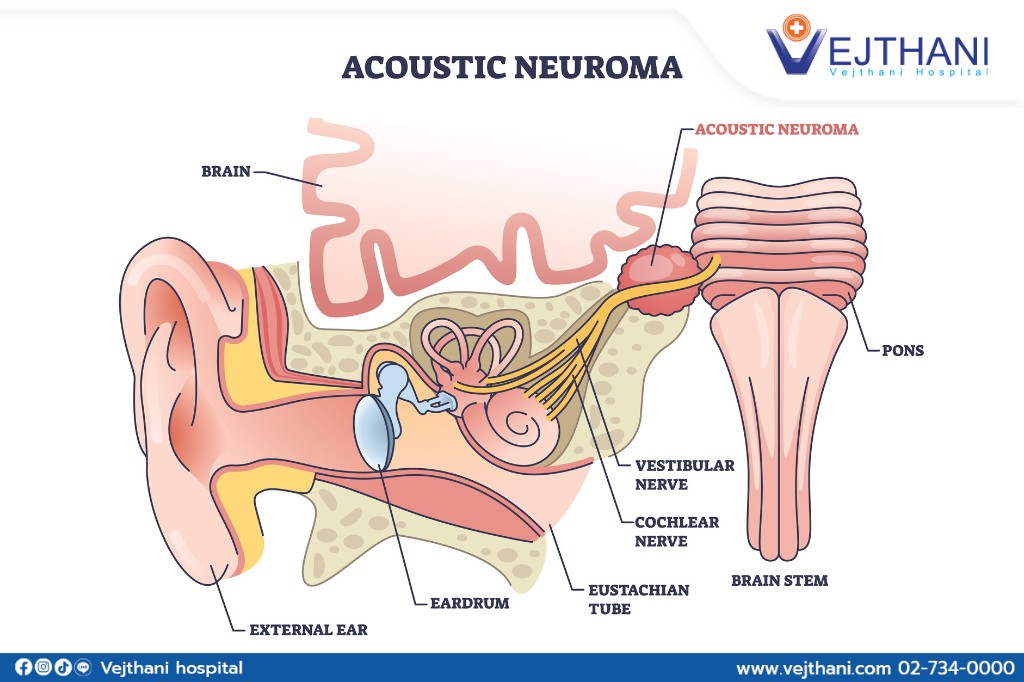
Overview
The major nerve (vestibular) that connects your inner ear to your brain might develop a noncancerous growth called an acoustic neuroma, also known as a vestibular schwannoma. Branches of this nerve directly affect your balance and hearing. The pressure from an acoustic neuroma can cause hearing loss, ringing in the ears, and loss of balance.
Acoustic neuromas commonly developed from the Schwann cells, which often grow slowly or not at all. Occasionally, it may develop quickly and grow big enough to press up against the brain and vital structures.
Regular monitoring, radiation therapy, and surgical removal are among options for treating acoustic neuromas.
Around 50% of patients with small to medium tumors who had healthy hearing prior to surgery still do so thereafter. Hearing loss can be helped by hearing aids.
Symptoms
Acoustic neuroma signs and symptoms can take years to manifest and are sometimes simple to miss. These typically occur as a result of the tumor’s impact on the nerves that control hearing and balance. Problems could also arise from pressure from the tumor on surrounding nerves regulating facial muscles and sensation (such as the trigeminal and facial nerves), nearby blood vessels, or brain structures.
The signs and symptoms may become more obvious or severe as the tumor enlarges.
The following are typical auditory neuroma symptoms and signs:
- Hearing impairment typically progresses gradually over a period of months to years, but in rare instances, it may occur suddenly. It can affect one ear or be more pronounced in one ear compared to the other.
- Imbalance or unsteadiness
- Dizziness or vertigo
- Tinnitus, or ringing, in the impacted ear
- Vomiting and nausea
- Headaches
- Problem swallowing
- Changes in taste
- Numbness in the face, as well as muscle weakness or lack of mobility
Rarely, an auditory neuroma may enlarge to the point where it compresses the brainstem and poses a life-threatening threat.
If you experience balance issues, ringing in your ears, or hearing loss in one ear, consult a doctor.
An acoustic neuroma may be prevented from becoming large enough to have catastrophic effects, such as total hearing loss, with early detection.
Causes
An issue with a gene on chromosome 22 may be the root of auditory neuromas. Usually, this gene creates a tumor suppressor protein that aids in regulating the expansion of Schwann cells, which cover the nerves.
Scientists are unsure of what is causing this gene-related issue. There is no known cause for the majority of acoustic neuroma instances. This defective gene is also inherited in neurofibromatosis type 2, a rare condition that often manifests as tumor growth on both sides of the head’s hearing and balance nerves (bilateral vestibular schwannomas).
Risk factors
Neurofibromatosis type 2
Having a parent with the rare genetic condition neurofibromatosis type 2 is the sole known risk factor for auditory neuroma. However, only about 5% of instances of auditory neuroma are caused by neurofibromatosis type 2.
The growth of noncancerous tumors on the hearing and balance nerves on both sides of the head, as well as on the other nerves, is a defining feature of neurofibromatosis type 2.
Autosomal dominant disorders, such as Neurofibromatosis type 2 (NF2), allow the mutation to be passed down from just one parent (dominant gene). There is a 50/50 probability that each child of a parent who is affected will inherit it.
Diagnosis
The first step in identifying and treating an acoustic neuroma is frequently a complete physical examination that includes an examination of the ears.
Early diagnosis of acoustic neuroma is frequently challenging because the disease’s signs and symptoms can be easily missed and gradually worsen over time. Numerous other middle and inner ear conditions are linked to many common symptoms, including hearing loss.
Your doctor will perform an ear exam after asking you questions regarding your symptoms. These tests could be requested by your doctor:
- Hearing test (audiometry). You participate in a hearing test when sounds are played into each ear one at a time by an audiologist. The audiologist plays a variety of tones of sounds and asks you to respond each time you recognize one. To test your hearing, each tone is replayed several times at progressively lower volumes.
Also, the audiologist could use a variety of terms to gauge your hearing capacity. - Electronystagmography. To assess the health of your eye and ear nerves, examines balance and records eye movement.
- Auditory brainstem response. Evaluates the brainstem’s functionality and the hearing nerves’ response to sound.
- Imaging. In order to diagnose an acoustic neuroma, Magnetic Resonance Imaging (MRI) with contrast dye is typically employed. Tumors as tiny as 1 to 2 millimeters in diameter can be found with this imaging procedure. Computerized tomography (CT) may be utilized if an MRI scan is not possible or is not an option for you for some other reason. Yet, tiny cancers may be missed by CT scans.
Treatment
One of the acoustic neuroma treatments available at Vejthani Hospital is surgical excision of the tumor by a qualified neurosurgeon.
Your acoustic neuroma’s course of treatment may change based on:
- General health
- Severity of your symptoms
- The acoustic neuroma’s size and rate of growth
Your doctor can advise monitoring, surgery, or radiation therapy as possible treatments for acoustic neuromas.
Monitoring
You and your doctor may opt to keep an eye on a small acoustic neuroma that isn’t growing or is growing slowly and causing few or no signs or symptoms. If you’re an older adult or otherwise not a good candidate for more severe therapy, monitoring may be advised.
Every 6 to 12 months, on average, your doctor may advise that you undergo imaging and hearing tests to check on the tumor’s rate of growth. You might need to receive therapy if the scans reveal the tumor is expanding or if the tumor results in worsening symptoms or other issues.
Surgery
An auditory neuroma may require surgery to be removed, particularly if it is still growing, is very large, and is causing symptoms.
Depending on the size of the tumor, your hearing condition, and other circumstances, your surgeon may employ one of many procedures to remove an acoustic neuroma. During surgery, the objective is to extract the tumor while safeguarding the facial nerve to avoid any facial paralysis. When a tumor is too close to the brain or facial nerve tissue, for instance, complete removal of the tumor may not be possible.
Under general anesthesia, the tumor is removed from the acoustic neuroma either through the inner ear or a window in the skull. In some cases, surgically removing a tumor may make symptoms worse if the facial, hearing, or balance nerves are irritated or hurt during the procedure. On the side of the procedure, hearing loss is possible, and balance is typically momentarily compromised.
Radiation therapy
The following radiation therapies can be used to treat auditory neuromas:
- Stereotactic radiosurgery. Stereotactic radiosurgery is a form of radiation therapy that your doctor might advise. If your tumor is small (less than 2.5 cm in diameter), you’re an older adult, or you can’t handle surgery for medical reasons, it’s frequently employed.
In stereotactic radiosurgery, such as with the Gamma Knife, a tumor is given a precise dose of radiation without causing damage to the surrounding tissue or requiring an incision.
Stereotactic radiosurgery aims to limit a tumor’s growth while also protecting the function of facial nerve and, maybe, hearing.
You might not experience the effects of radiosurgery for weeks, months, or even years. With subsequent imaging tests and hearing evaluations, your doctor will keep track of your improvement.
- Stereotactic radiotherapy. Through a series of sessions, fractionated Stereotactic Radiotherapy (SRT) administers a modest dosage of radiation to the tumor. SRT is used to stop the tumor’s growth without harming the surrounding brain tissue.
- Proton beam therapy. High-energy beams of positively charged particles called protons are used in this type of radiation therapy. To treat tumors and reduce the amount of radiation that the surrounding area is exposed to, protons are supplied to the afflicted area in precise dosages.
Supportive therapy
Your doctor may suggest supportive therapy to address symptoms or side effects of an acoustic neuroma and its treatment, such as dizziness or balance issues, in addition to treatment to remove or stop the growth of the tumor.
Hearing loss can also be treated with cochlear implants or other methods.



