Achilles tendon rupture
 Make an Appointment
 Talk to Doctor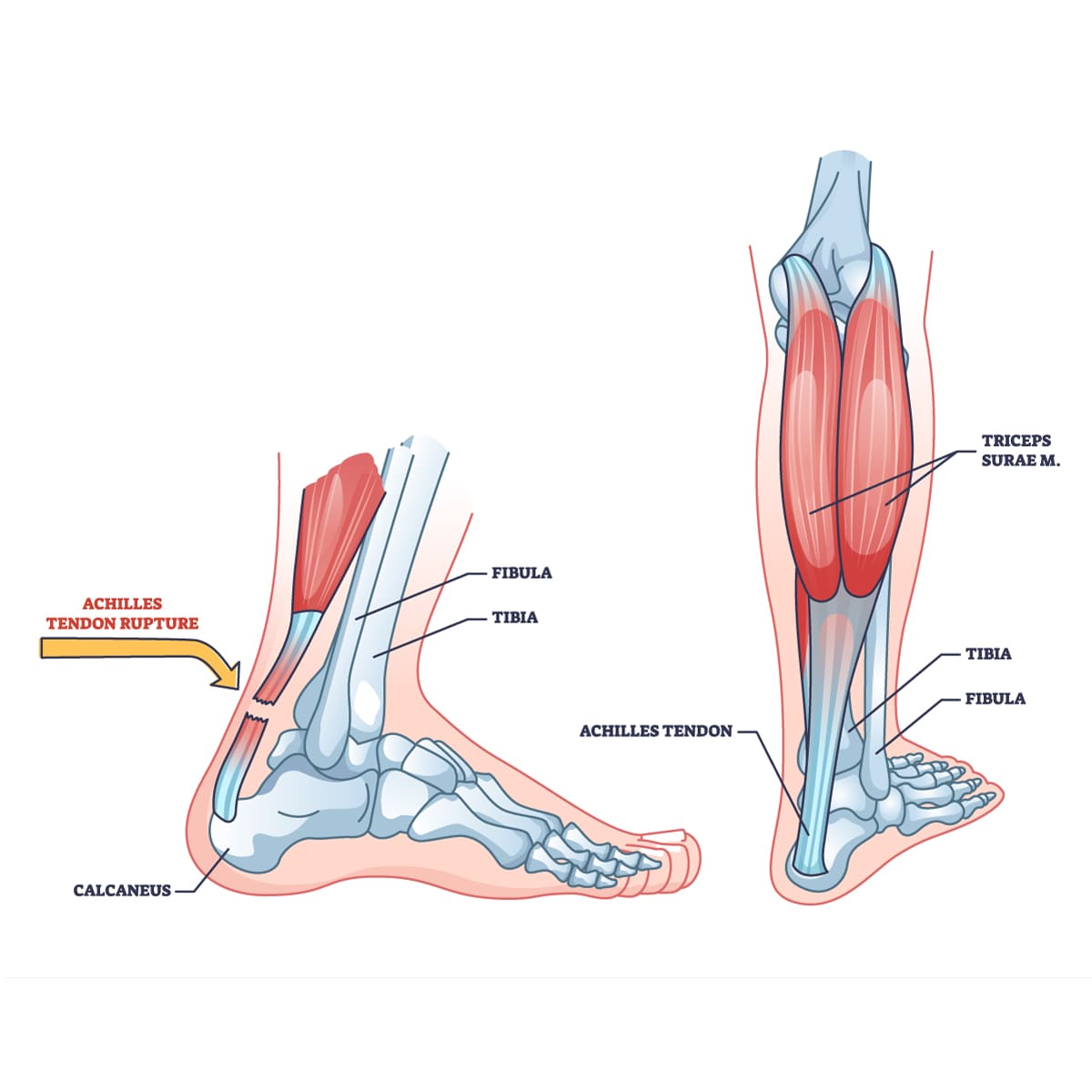
Overview
The Achilles tendon are a tough fibrous connective tissues of the muscle attaching the calf to the heel bone. It is essential in most of the foot’s movement such as lifting the foot down, rising up the body using the toes and pulls the foot when walking.
When you injure the back of your lower leg due to sports or any activities, it may result in rupture or tear the Achilles tendon either partially or completely. This condition is called Achilles tendon rupture.
Signs & Symptoms
Achilles tendon rupture can be asymptomatic but the following symptoms can usually occur:
- A popping sound during the injury
- Inability to bend the foot downward or push off the affected leg during walking
- Feeling of being kicked in the calf
- Bruising at the back of the lower leg
- Inability to stand using the toes on the affected leg
- Sudden sharp pain and swelling on the injured heel area
When you hear a popping sound on your heel area or you can barely walk after the injury, you have to consult a sports medicine or orthopedic specialist immediately.
Causes
A strong force applying on the foot area may cause the Achilles tendon to rupture. The healing process is often slow where this area is also known to have not much supply. The most common cause or Achilles tendon rupture are:
- Fall from height
- Extreme sports with a lot of jumping
- Stepping inside loops.
Risk factors
Common risk factors that leads to Achilles tendon rupture, are as follows:
- Gender. Men are more prone to Achilles tendon rupture than women.
- Age. More common in 30 to 40 years old individuals.
- Obesity. Overweight people puts more loads on the tendon.
- Sports. Games which involve running, jumping, pivoting sudden switch of movements such as playing soccer, tennis, basketball, football and squash.
- Use of certain medications. Steroid injection which is used to reduce the pain and inflammation may also decrease the strength of the tendons and lead to its rupture. Some antibiotics such a fluoroquinolones (e.g., ciprofloxacin and levofloxacin) may also cause an Achilles tendon rupture.
Diagnosis
The doctor will perform a physical examination to investigate for any gap in the tendon, swelling and tenderness, which may suggest a sign of Achilles tendon ruptured. You will also be asked to move at a certain motion and position to check for the presence of your reflexes.
An ultrasound or Magnetic Resonance Imaging (MRI) may also be recommended to view your tendon if it has partially or fully ruptured.
Treatment
Elderlies would usually prefer non-invasive treatment. In younger age, as well as those who are more physically active, and those who acquired more serious injuries, the treatment method tends to move toward a surgical treatment.
Nonsurgical Approach
The following technique may help:
- Rest the affected back of the lower leg area for a few weeks
- Elevate your feet to decrease swelling
- Cold compression
- Over-the-counter pain reliever
- Using a walking aid device such as crutches, a heeled walking boot pointing downwards or cast to rest the tendon
Nonsurgical techniques may help but Achilles tendon rupture can recur with longer recovery time.
Surgery
Minimally invasive surgery can be done to repair the ruptured Achilles tendon. Surgical approach involves making a tiny incision at the back of the lower leg to access the tendons and repair them.
Rehabilitation
Physical therapy can be done after a non-surgical or surgical treatment to regain muscle strength and stability. Eventually, it will return back to normality within four to six months, although in some case the symptom and pain could last up to a year. Functional physical therapy is a type of rehabilitation which trains the body to coordinate and move to restore regular movements.



