 Make an Appointment
 Talk to Doctor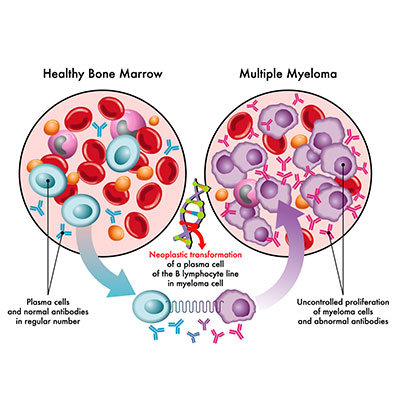
Overview
Multiple myeloma is the development of a rare blood cancer that affects the plasma cells (also called B cells). Plasma cells are a type of white blood cell that help the body fight infections by producing antibodies called immunoglobulins.
Multiple myeloma occurs when abnormal cells multiply and produce antibodies knows as M proteins. As this happens, the disease can affect the bones, kidneys, and the ability to produce healthy blood cells.
Multiple myeloma could affect a person without any symptoms, The disease is slow progressive during the early stage, and the immediate treatment is not necessary, however, regular monitoring for the signs and symptoms is recommended to slow the progression of the disease.
Symptoms
Signs and symptoms of Multiple myeloma are as follows:
- Numbness or weakness of the arms and legs.
- Brain fog or confusion
- Bone pain
- Unexplained weight loss
- Nausea and vomiting
- Loss of appetite
- Frequent infection
- Unexplained bruising or bleeding
If you notice any signs and symptoms that are persistent then you could make an appointment with your doctor.
Causes
The cause of multiple myeloma is still unclear. It is known that the disease develop from just one abnormal plasma cell in the bone marrow that has rapid multiplication. The cancer cells do not mature and die as normal cells do. Once this multiplication of cancer cells occurs, the healthy cells become less and therefore the body is not able to fight the infection and becomes fatigued.
The myeloma cells produce abnormal antibodies, known as Monoclonal proteins or M proteins. These begin to build up in the body causing damage to the bones and the kidneys.
Monoclonal gammopathy of undetermined significance (MGUS), a generally benign condition, is usually the initial stage of multiple myeloma. Similar to multiple myeloma, MGUS is characterized by the presence of M proteins in your blood, which are made by abnormal plasma cells. Although there is no bodily harm, M protein levels are lower in MGUS.
Risk factors
Factors that may increase leukemia risk includes.
- Family History: it is highly possible to develop multiple myeloma if a direct member of the family is diagnosed with the disease.
- Age: those who are older are more prone to have multiple myeloma. Most patients diagnosed with the cancer are more than 65 years old.
- Gender: males are more likely to develop multiple myeloma than women.
- Obesity: person who are overweight or obese are high risk for the disease.
- Other plasma cell disease: person with monoclonal gammopathy of undetermined significance (MGUS) or solitary plasmacytoma has a higher risk to develop the disease.
Diagnosis
Routine blood test results could help the physician identify if the patient have a multiple myeloma, however it may require further testing for proper diagnosis.
- Complete blood count: to check for abnormalities in red blood cells, white blood cells count, and platelets.
- Blood test: patient’s blood may be analyzed in a lab to look for M proteins made by myeloma cells. Beta-2-microglobulin is a different abnormal protein made by myeloma cells that may be found in the blood and provide the specialist with information about how aggressive the myeloma. Blood tests to check your calcium levels, uric acid levels, and kidney function can also provide your doctor with information on your diagnosis.
- Urinalysis: urine analysis may reveal M proteins, also known as Bence Jones proteins when they are found in urine
- Bone marrow biopsy and aspiration: A long, thin needle is inserted into the bone marrow (commonly at the pelvic bone) to aspirate fluid during the procedure, then the sample is sent to laboratory for testing to determine the percentage of abnormal cells. A test called fluorescence in situ hybridization (FISH) will be used to analyze myeloma cells to identify gene mutations.
- Imaging test: To identify bone issues brought on by multiple myeloma, imaging studies will be recommended. An MRI, CT, positron emission tomography (PET), or an X-ray are examples of possible tests.
Staging
After the diagnosis of the multiple myeloma is confirmed, staging will be used to identify the extent of the cancer. The stages of cancer are indicated by Roman numerals ranging from I to III. The lowest stage indicates that the disease is less aggressive and the highest stage – stage III – indicates that the disease is most aggressive.
The staging will help the specialist to provide the most appropriate treatment.
Treatment
Treatment can improve symptom-related discomfort, manage disease complications, stabilize your condition, and slow the spread of multiple myeloma
There may be no need for immediate treatment. Smoldering multiple myeloma, which is characterized by the absence of symptoms in multiple myeloma, may not require immediate medical attention. If multiple myeloma is diagnosed early and is slow-growing, immediate treatment might not be required. Even so, the specialist will have regular checkup with the patient to look for symptoms of a developing disease. Regular blood and urine tests may be required for this.
The specialist and the patient may plan out and may decide to start treatment if the patient exhibit symptoms or if the multiple myeloma demonstrates indicators of progression.
- Targeted therapy – focuses on a specific part of the cancer cells by focusing on the weaknesses of the cells and therefore blocking the abnormalities. The therapy cause cancer cells to die.
- Immunotherapy – will help the immune system fight the cancer by boosting the immune system.
- Chemotherapy – uses drugs to kill cancer cell. Prior to bone marrow transplant, higher dose of chemotherapy drugs are given to kill the cancer cells.
- Steroids/ Corticosteroid – will help kill the cancer cells and prevent or reduce inflammation in the body.
- Bone marrow transplant (stem cell transplant) – will replace the bone marrow with healthy stems cells that will help in the formation of healthy bone marrow.
- Radiation therapy – High-powered energy beams from sources like X-rays and protons are used in radiation treatment to kill cancer cells. When a group of abnormal plasma cells forms a tumor (plasmacytoma) that is inflicting pain or damaging bones, it may be used to rapidly shrink myeloma cells in that location.



