 Make an Appointment
 Talk to Doctor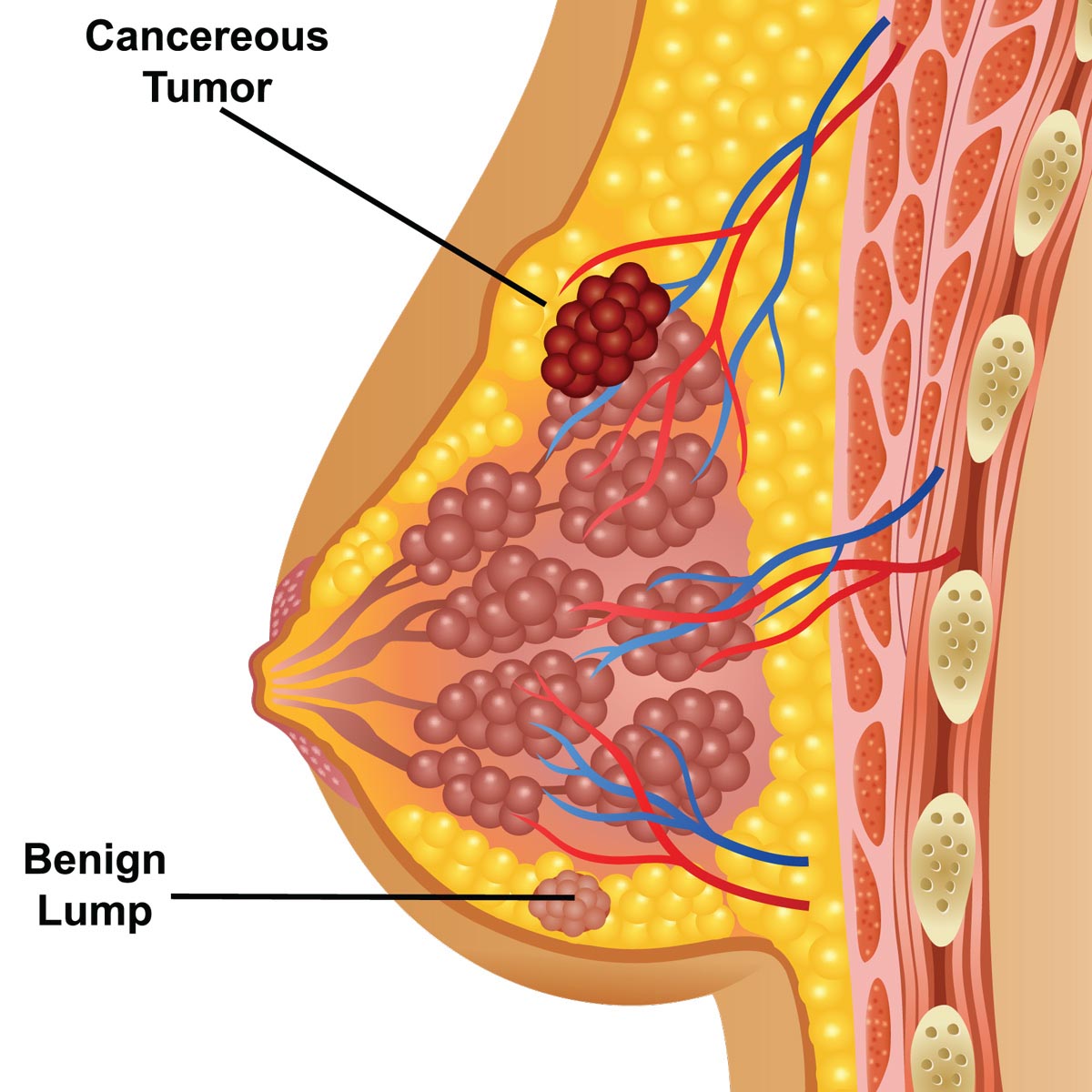
Overview
Breast cancer occurs when breast cells have abnormal growth. It usually begins in the cells of the milk-producing ducts (invasive ductal carcinoma), the lobules (invasive lobular carcinoma) or other tissues of the breast. The mutation of breast cell causes uncontrolled duplication resulting in forming a mass of cells also known as a breast tumor. This tumor then begins to invade and destroy the healthy tissues. These cells have the tendency to metastasize (spread to other parts of the body).
Breast cancer is one of the most common cancer in women. However, men are also at risk for breast cancer as well.
It can be categorized by staging from 0 up to IV. Stage 0 means that the cancer is localized in the milk ducts only while stage IV means that the cancer has spread to other parts of the body (metastasis).
Symptoms
Breast cancer may have the following signs and symptoms:
- Change in the size, shape of the breast
- Changes in the breast, like skin dimpling or bulging
- Sign of redness over the surface of the breast, swollen like the appearance of an orange peel, open wound that does not heal, rash surrounding the nipple that cannot be cured
- A lump or thickening of the breast
- A lump in the underarm
- Inverted or retracted nipple
- Unusual nipple discharge such as blood or a clear fluid
- Non-cyclical breast pain or pain that is unrelated to menstrual cycle
If you have any of these symptoms, consult a breast doctor immediately. Early diagnosis of cancer increases the chance for successful treatment.
Causes
The cause of breast cancer is unknown but environmental and genetic factors may have an influence to it.
Breast cancer is a commonly inherited mutated genes by about 5 to 10 percent of the disease population. There are 2 genetic mutations identified to increase risk of developing breast cancer which are breast cancer gene 1 (BRCA1) and breast cancer gene 2 (BRCA2). These two have higher chances of developing cancer of the breast and ovaries. Having a family history of breast cancer will show certain BRCA mutations or other familial genes which can be detected through blood test that the doctor will advise.
Risk factors
The following factors have high risks of developing the disease:
- Old age. Over the age of 50.
- Smoking. Tobacco smoking has been one of the risk factors of numerous types of cancers, which includes breast cancer.
- Being overweight or obese. Has a higher risk to develop breast cancer and also its recurrence.
- Alcohol consumption. Increases the risk of some types of breast cancer.
- Gender. Women have higher chance of developing breast cancer.
- Personal history of breast conditions. Atypical hyperplasia of the breast or lobular carcinoma in situ (LCIS) as a result of breast biopsy.
- Breast cancer history. Having a history of breast cancer in one breast may also develop the disease on the other breast later on.
- Family history of breast cancer. If first-degree relative (mother, sister or daughter) had breast cancer.
- Inherited genes that increase cancer risk. Having BRCA1 and BRCA2 genetic mutations passed on from parents.
- Radiation exposure. Receiving chest radiotherapy from childhood or young adulthood
- Early onset of menstruation. Women who started period before age 12 years have a higher risk of breast cancer.
- Late menopause. Experiencing menopausal at an older age.
- Having a child at an older age. Giving birth after 30 years old.
- Postmenopausal hormone therapy. Combination of estrogen and progesterone as hormonal therapy.
- Have never been pregnant
Diagnosis
Breast cancer can be diagnosed by undergoing the following procedures:
- Breast exam. The doctor will examine the breast for abnormalities or lumps starting from breasts to the armpits.
- Mammogram. It functions like an x-ray and if any abnormalities were found on a screening mammogram, you will be sent for a diagnostic mammogram.
- Breast ultrasound. It is an imaging test that sends high-frequency sound waves through the breast and converts them into images on a viewing screen. This examination is used to assess breast tissue, also used to assess blood flow to areas inside the breasts.
- Biopsy. It is a test used to identify the cause of an abnormal lump or tumor in the breast. A sample of the tissue will be collected and checked in the laboratory in order to find out whether the abnormal tissue is breast cancer or not.
The biopsy result will also help determine the cell type involved, the cancer grade, and possible treatment options.
The following are different types of biopsies typically used in early cancer detection:- Fine Needle Aspiration (FNA) Biopsy
- Stereotactic Core Biopsy
- Needle (Wire) Localization Biopsy
- Breast Magnetic Resonance Imaging (MRI). Creates images inside the breast using magnetic field and radio waves. A dye will also be injected prior to MRI for clearer images.
Treatment
Breast cancer treatment option is chosen based on its type, grade, stage, size and hormone sensitivity. Women mostly undergo surgery to remove breast cancer as well as chemotherapy, hormone therapy or radiation.
Breast cancer surgery
Surgeries performed to treat breast cancer:
- Lumpectomy. This surgery removes the breast cancer and some tissues surrounding it. Indicated for smaller tumor but if performed in a larger tumor, chemotherapy should be done prior to surgery to facilitate tumor shrinkage and remove it easily.
- Mastectomy. The surgery removes all breast tissues.
- Sentinel node biopsy. The sentinel lymph nodes are removed in this procedure and sent to pathology for examination under a microscopic to check for cancer type. The sentinel lymph node is believed to be the first lymph node which breast tumor spread to. The procedure is done by injecting a dye to detect which lymph node to remove. Once laboratory test results to cancer-free lymph nodes, there is no need to remove other lymph nodes.
- Axillary lymph node dissection. If sentinel lymph node biopsy results positive for cancer, the surgeon will recommend to remove all or most of the underarm lymph nodes group.
- Contralateral prophylactic mastectomy or removing both breasts. If there is a strong family history of breast cancer, some women will opt to remove the breast with cancer as well as the other breast that is healthy. Although, some may not develop cancer on the healthy breast, it would be best to consult your doctor for best recommendations.
Breast reconstruction is also possible after breast cancer surgery and you may be referred to a plastic surgeon to discuss your options.
Radiation therapy
This is the use of high-energy rays or particles to treat the disease. It is done by killing tumor cells or inhibiting their growth and duplication. Years of study by radiation oncologists have led to the widespread use of effective, tolerable doses of radiation. It may be used in more advanced breast cancer to control the disease or to treat symptoms such as pain.
Chemotherapy
The use of specific drugs to kill cancer cells. This medication usually administered orally or intravenously. Chemotherapy enters the bloodstream and travels throughout the body. The treatment is most commonly used to decrease risk of recurrent tumor after surgery, shrink breast cancer after surgery when the tumor is large or inflamed, and control metastatic breast cancer which has spread to other organs in the body.
Hormone therapy
The change of hormonal environment in your body, impacts the growth and behavior of some breast cancers. If your breast cancer produces one of the hormone receptors estrogen receptor (ER) or progesterone receptor (PR) then hormonal therapy is effective in treating early-stage, metastatic or advanced breast cancer and help preventing a recurrence.
Targeted therapy drugs
Targeted Therapy is a medication for cancer that has been developed to be exceptionally precise. Meaning, it will specifically targets cells that have a mutated receptor or targets the receptor that has the primary mechanism of developing cancer. This leads to obtaining a good result of the treatment and a positive response to medications.
Doctors may recommend this treatment if the breast cancer has metastasized to other locations of the body. Targeted therapy medications include monoclonal antibodies, antibody-drug conjugates and kinase inhibitors.
Immunotherapy
Immunotherapy is a type of cancer treatment that relies on the function of the patient’s immune system. Typically, the immune system keeps monitoring and destroying all of the foreign substances, such as germs or cancer cells. However, it cannot detect cancer cells sometimes. Immunotherapy helps to boost the effectiveness of the immune system to detect and fight against the cancer. Nevertheless, the oncologist will choose and plan the proper treatment that will suit with individual patient, depending on the type and stage of the cancer, as well as the patient’s overall health conditions.



