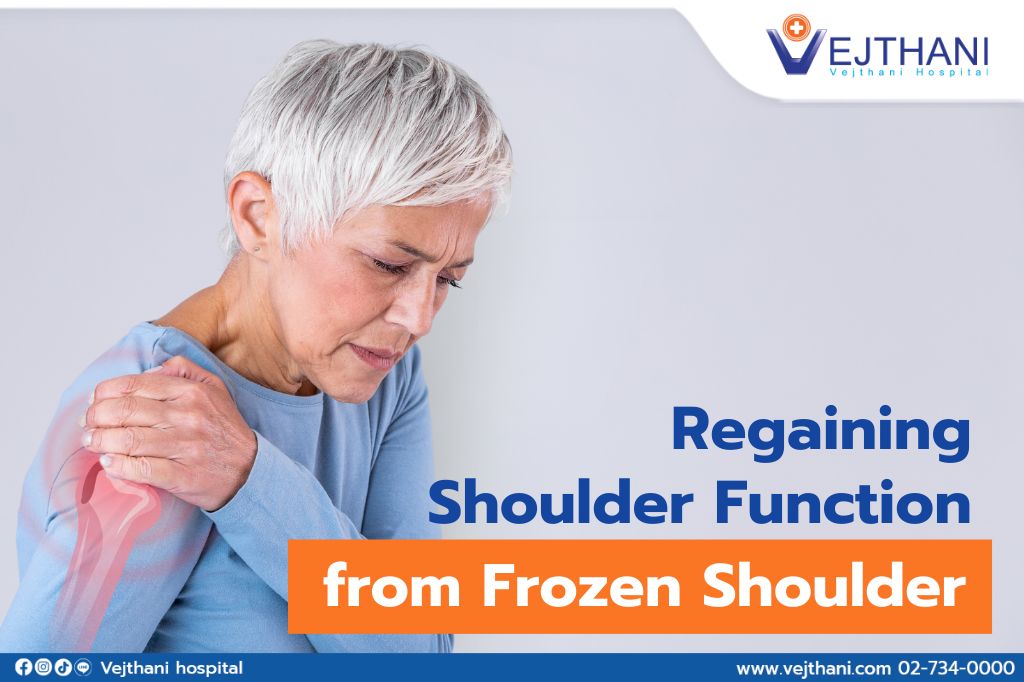
Frozen Shoulder: What Doctors Want You to Know Before It Gets Worse
Health Articles
Select Topic
What is Frozen Shoulder?
Frozen shoulder, medically known as adhesive capsulitis, is a condition characterized by progressive pain and stiffness in the shoulder joint. It results from inflammation and thickening of the joint capsule, causing a restricted range of motion and functional limitation.
Moreover, frozen shoulder often develops gradually and may significantly affect everyday life, such as reaching overhead, dressing, and sleeping comfortably. Although many patients eventually experience improvement over time, the duration and severity can vary.
Understanding the Shoulder Joint
The shoulder is a ball-and-socket joint that allows a wide range of motion. It is supported by:
A fibrous joint capsule
Ligaments
Tendons and muscles
Synovial fluid
In the frozen shoulder, the joint capsule becomes inflamed and fibrotic. Adhesions may form within the capsule, limiting mobility and causing pain during movement.
Stages of Frozen Shoulder
Frozen shoulder typically progresses through three stages:
1. Freezing Stage 0 – 3 ml
Gradual onset of shoulder pain
Increasing stiffness
Pain often worsens at night
2. Frozen Stage 3 – 12 ml
Reduced pain intensity in some cases
Marked limitation in active and passive movement
Functional impairment in daily tasks
3. Thawing Stage 12 – 18 ml
Gradual return of motion
Decreasing stiffness
Functional improvement over time
The entire course may last several months to more than a year, depending on individual factors.
Risk Factors
Frozen shoulder is more commonly found in:
Adults aged 40–60 years (Females more than males)
Individuals with diabetes mellitus
Patients with thyroid disorders
Those recovering from a shoulder injury or surgery
Individuals with prolonged shoulder immobilization
Usually resolves after 12-18 months
Diagnosis
Medical History: Assessment of symptom duration, pain characteristics, and functional limitations.
Physical Examination: Evaluation of active and passive range of motion. A hallmark finding is restriction in both directions, particularly external rotation.
Imaging Studies:
X-rays to exclude arthritis or structural abnormalities
MRI or ultrasound when differential diagnosis is necessary
Imaging helps rule out other shoulder conditions, such as rotator cuff tears or osteoarthritis.
Treatment Approaches
Treatment options depend on the stage and severity of symptoms and the patient’s health profile.
Non-Surgical Treatment:
Medications: Non-steroidal anti-inflammatory medicines (NSAIDs) may be prescribed to manage pain and inflammation
Steroid injections: This approach involves injecting corticosteroids directly into the shoulder joint to provide significant pain relief.
Physical Therapy: A personalized physiotherapy program can guide and ensure proper ways to improve the range of motion.
The objective is to reduce inflammation, preserve mobility, and minimize functional decline. Response to treatment varies among individuals.
Surgical Intervention
In cases where significant stiffness persists despite appropriate conservative therapy, the following surgical options may be considered.
Surgical and other procedures
Joint distension: This approach is also known as hydrodilatation. The doctor will inject sterile fluid into a stiff joint. This injection stretches the capsule and breaks down scar tissue.
Manipulation under anesthesia (MUA): This approach involves moving a stiff joint through its full range of motion while the patient is comfortably asleep. This breaks down scar tissue and adhesions that limit movement. Manipulation under anesthesia can significantly improve joint mobility, reduce pain, and increase the ability to engage in daily tasks.
Surgery: If frozen shoulder symptoms worsen, surgical intervention might become the most effective course of action. Arthroscopy is a well-established surgical technique that offers a minimally invasive approach to treatment. This procedure uses an arthroscope inserted through a small incision into the joint cavity, enabling direct visualization of the joint structures. The doctor will cut through the tight part of the shoulder joint and remove scar tissue. This procedure will help the patient regain a broader range of motion in the shoulder.
Frozen shoulder (adhesive capsulitis) can be a debilitating condition, but with proper diagnosis and treatment, regaining a full range of motion and returning to your usual lifestyle is certainly achievable. If you suspect you might have a frozen shoulder, consult a doctor specialized in shoulder joint surgeries to discuss the best course of treatment for you. Recovery from frozen shoulder takes time. Be patient with yourself throughout the process. With perseverance and proper guidance, you can overcome frozen shoulders and reclaim control of your shoulder function.
Dr. Sakkarin Bhaka, a sports medicine and shoulder joint surgeon at Vejthani International Hospital, focuses on diagnosing and treating shoulder disorders, including adhesive capsulitis and complex joint conditions. His clinical approach emphasizes:
Accurate differential diagnosis
Stage-specific treatment planning
Minimally invasive surgical techniques
Patients with underlying metabolic conditions, particularly diabetes, may experience prolonged recovery and require personalized treatment management.
We use cookies to manage your personal information in order to provide you with the best personalized user experience on our website. If you continue using the website, we assume that you accept all cookies on the website. Find out more.