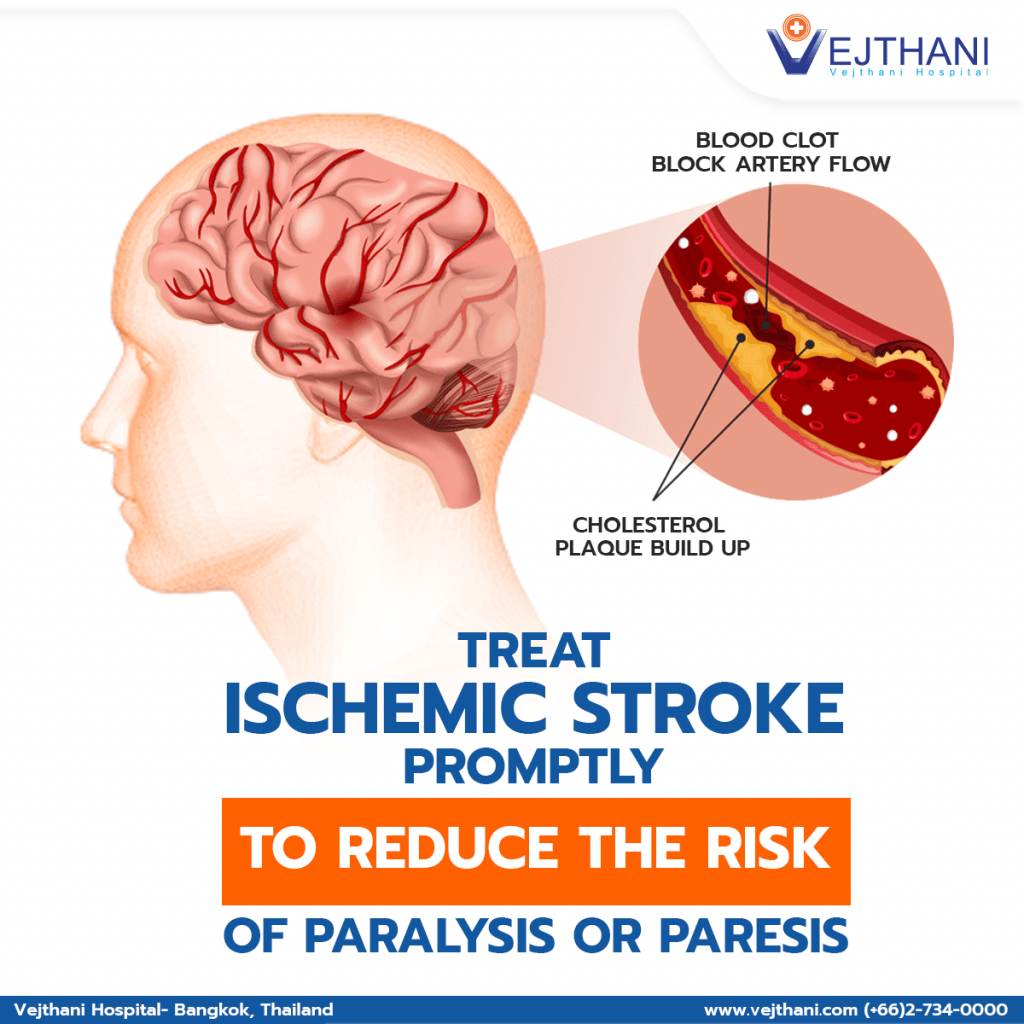
Treat Ischemic Stroke promptly to reduce the risk of Paralysis or Paresis
Health Articles
Select Topic
Cerebrovascular disease or strokes are the leading causes of paralysis or paresis. While people with the disease tend to suffer from sudden attacks, getting medical attention in time increases the chance of a cure.
Dr. Pongsakorn Pongsapas, a neurosurgeon at Vejthani Hospital, explained that cerebrovascular disease or strokes are caused by artery blockage, or stenosis or rupture of blood vessels in the brain that leads to disruption of blood flow to the brain, resulting in certain symptoms, such as facial palsy, blurred vision, double vision, weakness, numbness or paralysis on one side of the body, slurred speech or inability to speak. Strokes tend to occur in middle-aged and older people, but the condition is found the most in older adults as their blood vessels deteriorate with age.
Risk factors of strokes include:
Hypertension: People with blood pressure over 140/90 mmHg for an extended period will have their blood vessels degenerating faster than average. This elevates the risk of artery blockage, stenosis, or rupturing of blood vessels.
Diabetes: Causes blood vessel degeneration, which raises the risk of stroke-related problems.
Heartdisease: Includes cardiac arrhythmia, septal defect, and ischemic Cardiomyopathy. These may lead to the formation of blood clots that spread to blood vessels and arteries in the brain and cause blockage.
Hyperlipidemia: Causes inflammatory response and builds up of fatty deposits in the walls of the arteries that damage and lead to a risk of stenosis, leaking, or rupturing of the articles.
Smoking: Cigarettes contain chemicals that accelerate the degeneration of blood vessels in the brain. As the saying goes, “The more you smoke, the more you stroke,” smokers have six times higher risk of strokes than non-smokers.
Heavyalcoholconsumption: Causes the heart to malfunction, which results in plaques and blood clots spreading to the blood vessels in the brain and causing a blockage.
Obesityandlack of exercise: Exercising enhances the efficiency of the blood vessels, arteries, and the heart. It effectively helps prevent stroke and makes the heart function better, which significantly reduces the risks of developing strokes.
Strokes can be diagnosed with CT scan, MRI and MRA, Transcranial Doppler (TCD), and Carotid Doppler, among other methods. Precise diagnosis helps doctors to make an effective prevention and treatment plan.
The principle in treating stroke is to maintain the longevity and survival of brain cells. Adequate and uninterrupted blood circulation in the vessels will allow swift recovery of the brain tissues, enabling patients to regain their normal health condition. The doctor will start a clinical assessment in the initial stage of stroke treatment. If there are indicators for using anticoagulants as treatment without restrictions, the doctor will prescribe them to break up the blood clots that block the blood supply to the brain within 4.5 hours after the symptoms arise. However, if there is a blockage in the large blood vessels, the doctor will treat it by mechanical thrombectomy. The procedure involves inserting a catheter in the blood vessels through a small incision in the groin that leads to the brain to remove the blood clot. Mechanical thrombectomy is an endovascular technique that can be done quickly, resulting in minimal damage to the brain while preserving optimal brain function.
Patients should avoid the risk factors to lower the possibility of developing strokes by:
Keeping the blood pressure in the normal range
Avoiding consumption of food rich in cholesterol and saturated fats
Avoiding smoking and alcoholic beverages
Controlling the sugar level of diabetic patients
Keeping the body weight in the healthy range
Consuming more fruits and vegetables
Exercising regularly
“Strokes affect patients’ quality of life and their surrounding people. Therefore, apart from keeping themselves healthy, another important factor is watching out for unusual symptoms. Because if the condition is detected early, it’s possible to treat, which could reduce the risk of paralysis,” said Dr. Pongsakorn.
We use cookies to manage your personal information in order to provide you with the best personalized user experience on our website. If you continue using the website, we assume that you accept all cookies on the website. Find out more.