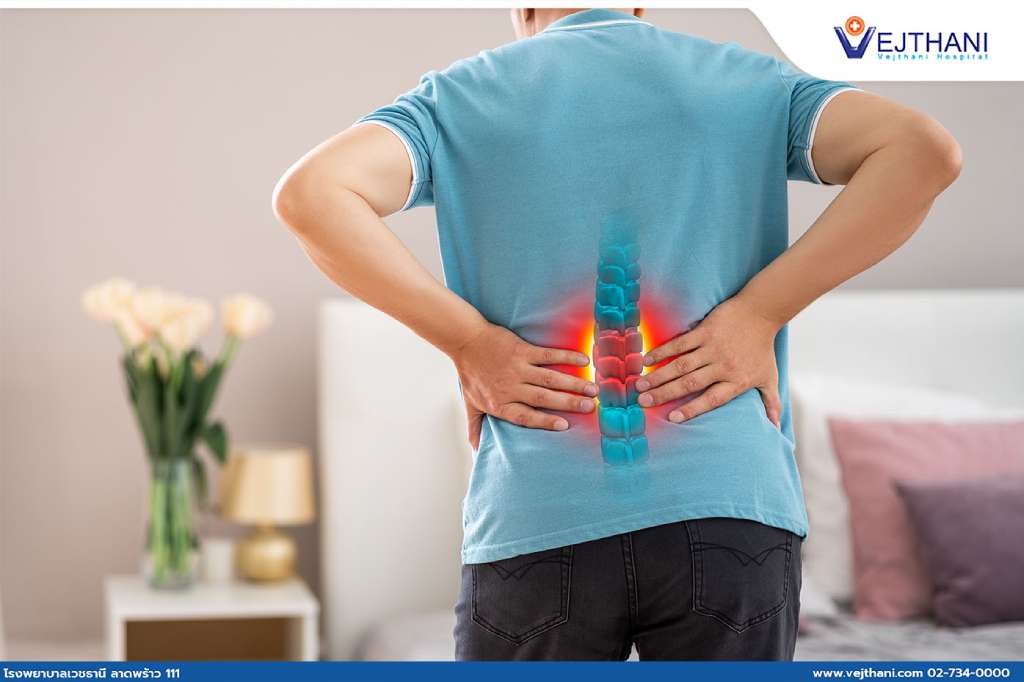
Treating Chronic Back Pain that Could Be a Sign of Herniated Disc
Health Articles
Lower back pain is a common complaint among working adults and is often dismissed as a minor health concern. However, sharp pain radiating from the back to the legs with numbness and muscle weakness can be a crucial indicator of a severe condition – a herniated disc, which can lead to paralysis.
Dr. Ekkaphol Larpumnuayphol, spine surgeon at Vejthani Hospital, explains that herniated disc, also known as spinal disc herniation, is a type of degenerative condition that occurs when the soft, gel-like substance in the center of spinal disc bulges or ruptures and compresses the nerves. This condition can occur after excessive use of the spine, such as lifting heavy objects, injuries that affect the spinal cord, or deterioration from age.
Herniated discs can occur in any position along the spine, from the neck to the lower part, causing back pain. Most patients will have muscle pain in the middle or lower back, which may present on one or both sides. The symptoms will worsen when coughing, sneezing, or bending over. In severe cases, numbness and muscle weakness may also arise.
The Severity of Herniated Disc
Initial Stage: When the spinal cord starts to deteriorate, back pain will be on and off. Over time, the pain intensifies gradually and persists for more than two weeks.
Intermediate Stage: When the spinal discs have slipped and bulged out, causing sharp back pain radiating down to the legs, potentially extending to the feet. Numbness may also be present in some cases.
Severe Stage: In the most severe stage, the nerve compression intensifies, and pain, numbness, and muscle weakness increase significantly until the nerve gets damaged and potentially lead to paralysis.
Doctors typically begin the diagnostic process for herniated discs by taking a detailed medical history and performing a physical examination. Imaging techniques such as computerized tomography (CT) scans or magnetic resonance imaging (MRI) scans are often used to visualize the spinal structures and confirm the presence and location of the intervertebral disc and nerves. MRI scans are beneficial in revealing a more precise location of nerve compression.
Non-surgical approaches are often the first treatment for mild to moderate cases. These may include medications such as pain relievers, muscle relaxants, or steroid injections to manage inflammation and pain.
Physical therapy can also promote muscle relaxation, reduce pain, and strengthen core muscles. To maximize its effectiveness, the treatment should be consistent and supervised by rehabilitation doctor and physical therapist.
Surgical intervention is required if medications and physiotherapy do not have satisfactory results. Currently, minimally invasive techniques like endoscopic spine surgery are a highly preferred treatment option. The doctor will insert a camera directly into the compressed nerve area to precisely locate and minimize muscle removal without the need for extensive incision, preserving as much healthy muscle as possible. This approach minimizes blood loss, reduces the risk of infection, and facilitates faster recovery because of the minor surgical incision (approximately 0.8 centimeters). Additionally, intraoperative neuromonitoring is used during the surgery to ensure safety by providing real-time monitoring of nerve function, thereby minimizing the risk of developing post-operative paralysis.
Daily exercises can help prevent herniated discs by strengthening muscles and delaying the deterioration of the spinal cord. Maintaining healthy body weight, avoiding smoking, practicing proper sleeping and sitting posture to prevent nerve compression on the spinal cord, and avoiding lifting heavy objects can all significantly reduce the risk of spinal injuries that contribute to disc degeneration. By prioritizing these preventive measures and seeking early medical attention for persistent lower back pain, people can minimize the risk of developing a herniated disc and its associated complications.
For more information, contact
Spine Center, Vejthani Hospital Call 02-7340000 or Ext. 5500 English Hotline: (+66)8-522 38888
We use cookies to manage your personal information in order to provide you with the best personalized user experience on our website. If you continue using the website, we assume that you accept all cookies on the website. Find out more.