Spondylolisthesis Can Be Treated with OLIF: A Minimally Invasive Spinal Fusion Option
Health Articles
Spondylolisthesis is a spinal condition that can cause significant back pain, leg pain, and difficulty walking due to vertebral slippage and nerve compression. In selected patients, spinal fusion surgery using the Oblique Lumbar Interbody Fusion (OLIF) technique may be considered as a minimally invasive option to restore spinal stability and improve quality of life.
At the Spine Center, Vejthani International Hospital, treatment decisions are based on doctor’s evaluation, and imaging findings.
Understanding Spondylolisthesis
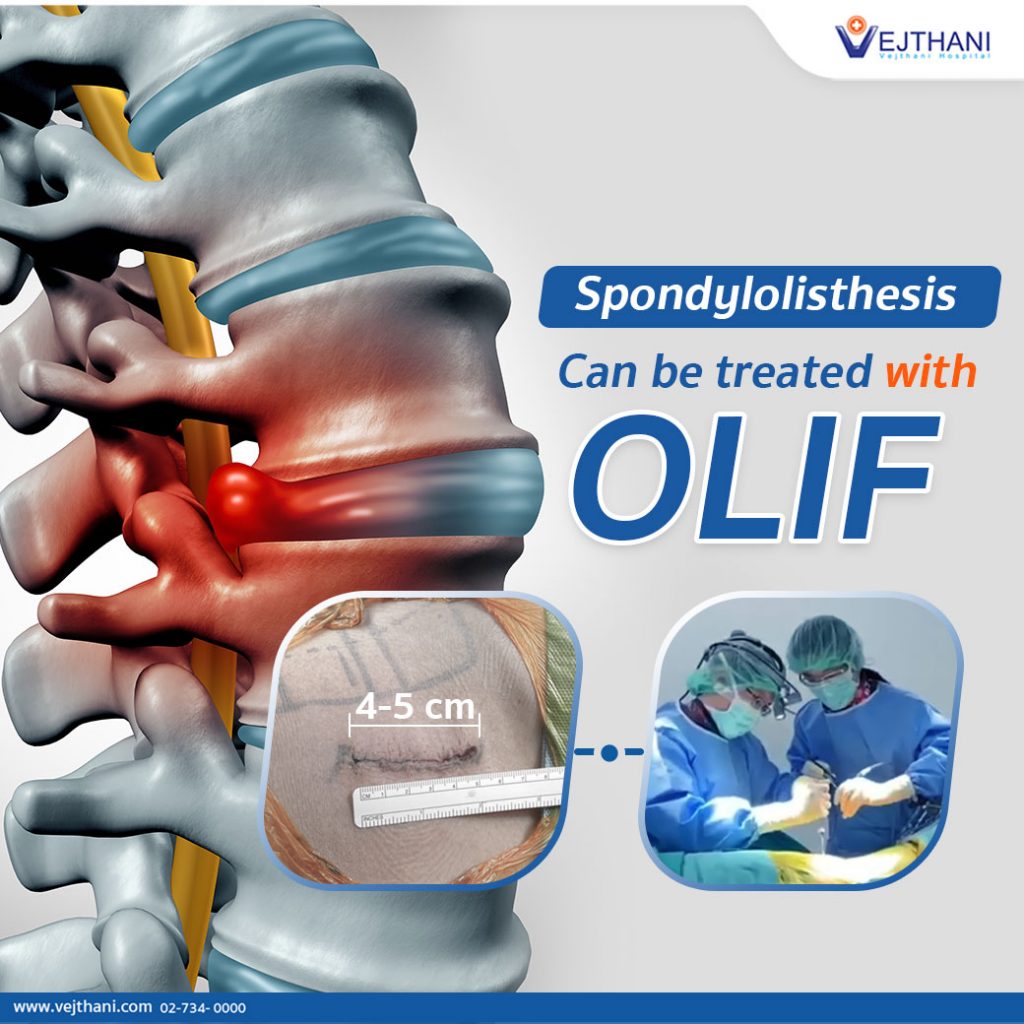
Spondylolisthesis occurs when one vertebra slips forward when compared to the vertebra below it, leading to spinal instability and possible nerve compression. The condition may affect both adolescents and adults and can worsen over time if left untreated.
Common symptoms include:
Lower back pain that worsens with movement
Pain radiating down one or both legs
Numbness or tingling in the legs
Muscle weakness affecting walking endurance
Stiffness in the lower back, hips, or thighs
When symptoms persist and significantly interfere with daily activities, further medical evaluation is required.
Causes and Risk Factors
Spondylolisthesis may result from different underlying mechanisms:
Degenerative changes of the spine in older adults
Congenital or developmental conditions, such as spina bifida
Spinal injury or repetitive mechanical stress
Lifestyle factors, including excess body weight, prolonged poor posture, heavy lifting, or high-impact sports
Identifying the cause is essential for selecting the most appropriate treatment approach.
Diagnosis
Before considering surgical treatment, spine specialists will perform a medical assessment, which may include:
Physical examination
X-ray imaging to evaluate vertebral alignment
MRI scans to assess disc damage and nerve compression
This diagnostic process helps determine disease severity and suitability for different treatment options.
Non-Surgical Treatment Options
In mild to moderate cases, initial treatment typically involves conservative measures such as:
Pain-relieving medications
Physiotherapy and rehabilitation
Activity modification
These treatments are usually continued for several weeks. Surgery is considered only when symptoms do not improve or worsen despite adequate non-surgical care.
When Is OLIF Considered?
Oblique Lumbar Interbody Fusion (OLIF) may be considered in selected patients with spondylolisthesis when:
Persistent pain or neurological symptoms affect daily life
Imaging shows spinal instability or significant disc degeneration
There is associated spinal deformity, such as scoliosis
Non-surgical treatment has failed to provide sufficient relief
The decision to proceed with OLIF is always individualized and made after thorough evaluation by spine specialists.
What is OLIF?
OLIF is a minimally invasive spinal fusion technique that accesses the lumbar spine through a small incision on the side of the body. This approach allows surgeons to avoid major back muscles while addressing the damaged intervertebral disc.
During the procedure:
The damaged disc is removed
A specialized implant (PEEK cage) is placed to restore disc height
Spinal alignment is corrected
Nerve compression is relieved
Because surrounding muscles and tissues are preserved, OLIF may offer advantages in selected cases.
Potential Benefits of OLIF
From clinical experience at the Spine Center, potential benefits of OLIF may include:
Smaller surgical incision (approximately 4–5 cm)
Reduced muscle and tissue disruption
Less blood loss compared to traditional open surgery
Lower risk of certain complications
Earlier postoperative mobilization in selected patients
Some patients may be able to stand or walk within 12–24 hours after surgery, depending on individual recovery.
Recovery and Postoperative Care
Recovery following OLIF varies between individuals. While hospital stay may be short in selected cases, full recovery and rehabilitation depend on overall health, disease severity, and adherence to postoperative care plans.
Long-term goals focus on spinal stability, pain reduction, and functional improvement rather than immediate symptom resolution.
Why Specialist Care Matters
Surgical treatment of spondylolisthesis requires expertise in spinal anatomy, biomechanics, and minimally invasive techniques. The Spine Center at Vejthani International Hospital brings together a highly experienced multidisciplinary team dedicated to delivering advanced spinal procedures.
Treatment planning emphasizes patient safety, evidence-based practice, and long-term outcomes.
Frequently Asked Questions
Is OLIF suitable for all patients with spondylolisthesis? No. OLIF is appropriate only for selected patients after medical evaluation.
How soon can patients walk after OLIF? Some patients may begin walking within 12–24 hours, depending on individual recovery and medical condition.
Does OLIF completely eliminate pain? Pain improvement varies between individuals. The primary goals are spinal stability and nerve decompression.
For more information, contact
Spine Center, Vejthani International Hospital Call 02-7340000 or Ext. 5500 English Hotline: (+66)8-522 38888
We use cookies to manage your personal information in order to provide you with the best personalized user experience on our website. If you continue using the website, we assume that you accept all cookies on the website. Find out more.